Private alpha · Early partners welcome
Real work,on the record.
One reproducible performance report per Sprint: authorship, assistance, communication and infrastructure incidents kept separate. Every claim carries its evidence ID.
A Sprint, not a coding test.
Enter through a clear pre-Sprint Brief, wait for the environment to become ready, then work inside the same IDE-style shell through tickets, reviews and formal work interactions.
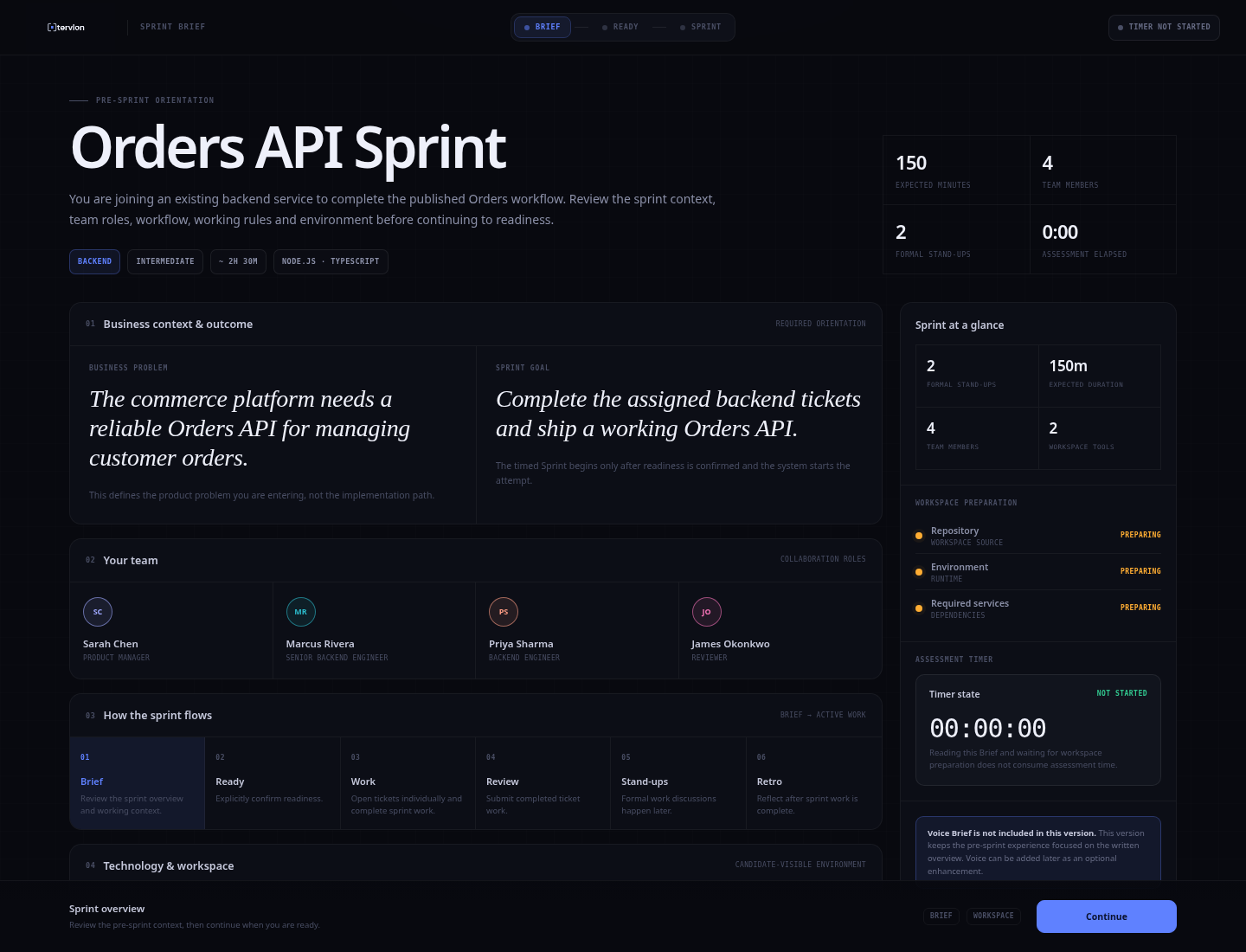
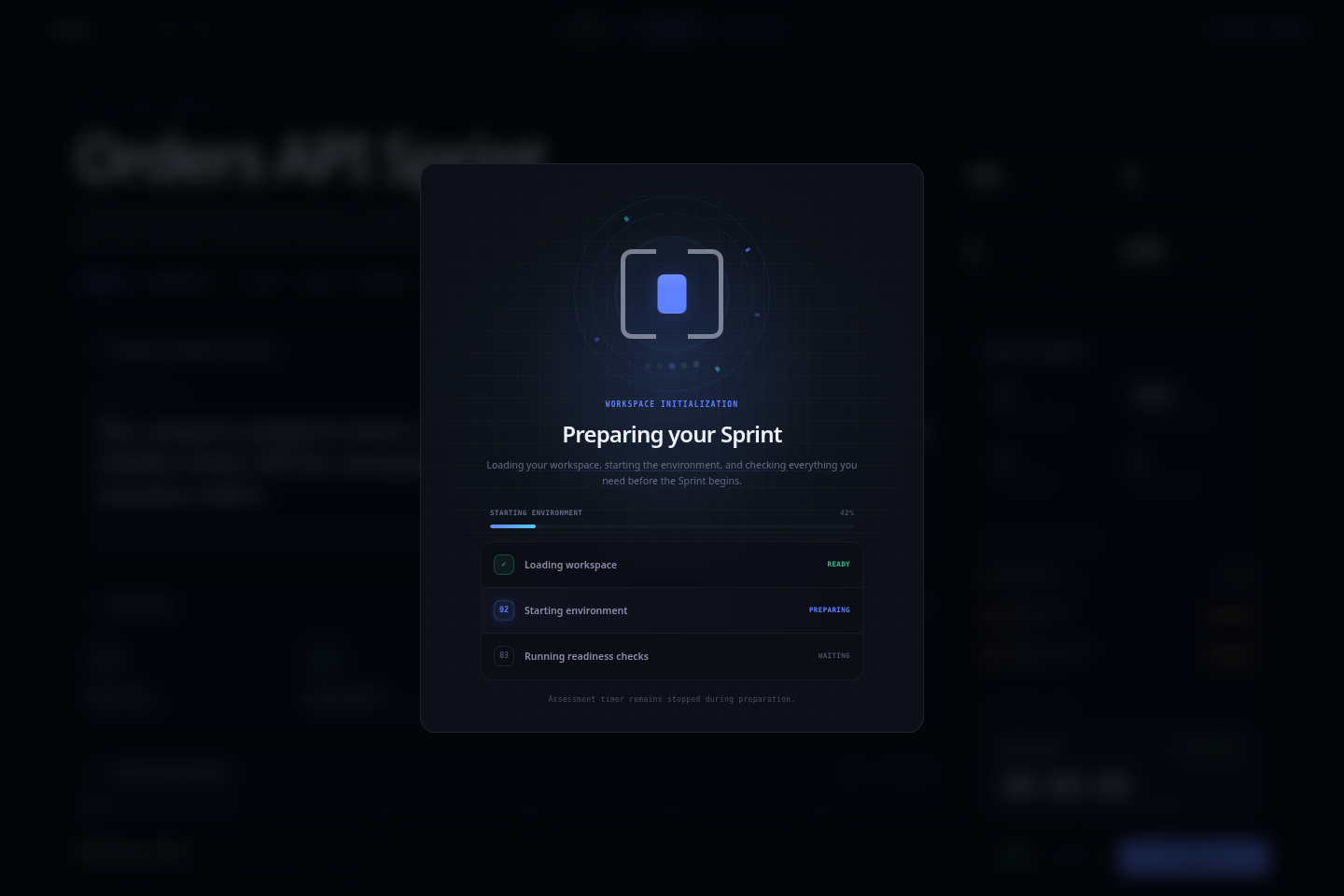
The candidate sees the business problem, team, working rules, environment and Sprint flow before active work begins.
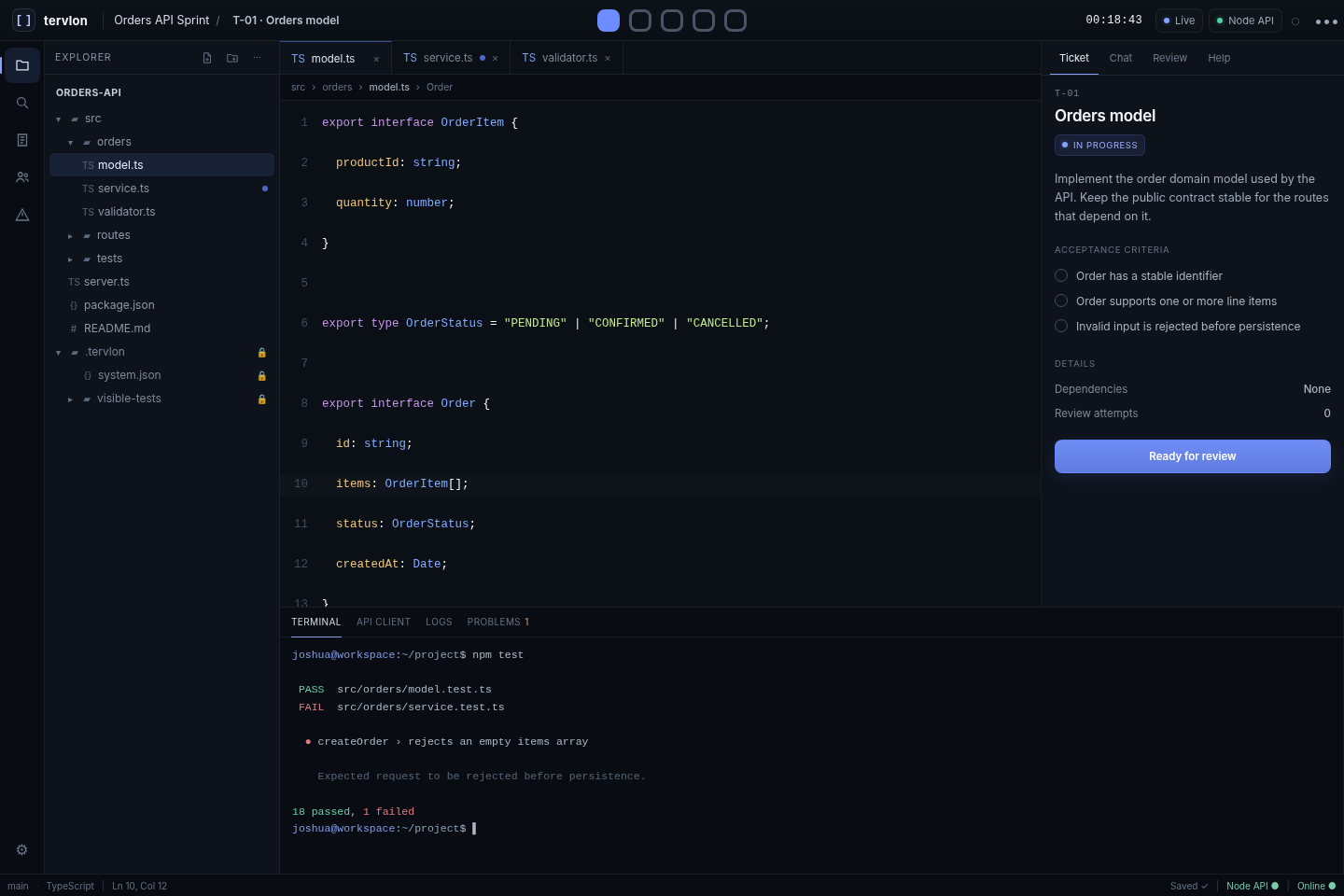
The candidate's engineering desk.
Work, context, runtime and process stay visually distinct without becoming unrelated tools. The Workspace feels compact, operational and familiar to anyone who has used a modern IDE.
Everything needed to ship the ticket, in one place.
Explorer, editor and terminal sit beside ticket context, chat, review and help. Backend Sprints can expose an API Client, while frontend Sprints can expose a Preview.
Review gates the next piece of work.
Work interactions happen during the work.
Stand-ups appear at scenario-defined progress boundaries and preserve the underlying Workspace.
Measure engineering behavior without turning the Sprint into a scorecard.
Before the Sprint, candidates see only the kinds of engineering behavior Tervlon observes. No weights, target scores or grading bars are shown in the pre-Sprint experience.
Whether the implementation satisfies the work correctly.
How the solution is structured, maintained and expressed.
How well the candidate understands and follows the work context.
How the candidate works with the simulated team and handles clarification.
How work progresses through a bounded Sprint.
Detailed values belong after the Sprint, once the work is complete.
One environment, three reasons to use it.
The same core Sprint can support hiring, structured assessment and deliberate practice without changing the underlying product mental model.
Evaluate work, not trivia.
Use a structured Sprint to see how a developer handles requirements, implementation, review, collaboration and time inside one realistic workflow.
Assess readiness in context.
Give learners a consistent engineering environment that goes beyond isolated exercises and exposes how they work through real software tasks.
Practice the parts tutorials miss.
Work through tickets, terminal output, review feedback, team interaction and Sprint progression in an environment built to feel like engineering work.
Give real engineering work a better signal.
Tervlon is in private alpha. We're inviting hiring teams, institutions and developers to help shape the first production release.